



Breast cancer: Knowledge and Awareness is Rescue.
What it is?
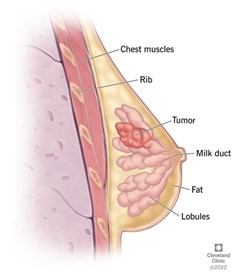
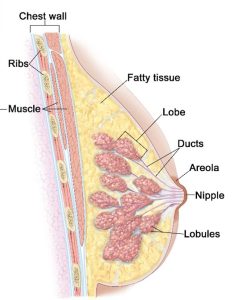
The three main components of a breast are connective tissue, ducts, and lobules. The glands that generate milk are called lobules. The tubes that transport milk to the nipple are called ducts. Everything is encased in and held together by the fibrous and fatty connective tissue.
Cancer that develops in the breast is known as breast cancer. It may begin in one breast or both. The condition occurs when breast cells grow uncontrollably, causing cancer to spread through blood vessels and the lymph nodes under the arms. Breast cancer is considered to have metastasized when it spreads to other bodily parts.
Figure 1. a: Normal breast tissue Figure 1. b: Breast cancer
Prevalence of it among female and male
Breast cancer accounts for almost 30% of all newly diagnosed cancers in women each year. Men account for 0.5-1% of all breast cancer cases. According to WHO, Breast cancer is the most common cancer among individuals, with about 2.3 million cases reported annually. Breast cancer is either the first or second leading cause of female cancer deaths in 95% of the world’s countries. All across the world, breast cancer affects women at any age after adolescence, however, its prevalence rises with age.
Figure 2: Breast cancer incidence worldwide
Risk factors of it
Age: Breast cancer incidence increases dramatically with age, peaks during menopause, and then progressively reduces or remains constant.
Gender: Breast cancer is the most common type of cancer in women. However, Male breast cancer (MBC) accounts for 1% of all breast cancers.
Hormonal changes: An elevated estrogen level as a result of obesity, testicular hormonal function impairment, or Klinefelter syndrome, and oral contraceptive usage in general were linked to an increased incidence of premenopausal breast cancer. It has also been found that women who take postmenopausal hormone replacement therapy have an increased chance of developing breast cancer, which increases with length of usage.
Family history: Genetic factors and family history of breast cancer also play a major role as a risk factor where Up to 20% of patients with a family history of breast cancer may carry a gene mutation that is linked with increased cancer risk.
Early menarche or menopause: Early age at menarche is linked to an increased risk of breast cancer. The link is crucial, and theories have been proposed that fast growth in childhood and excess calorie consumption throughout childhood are key drivers of breast cancer risk later in life, The age of menopause states women over 50 years of age are associated with an increased risk of breast cancer,
Other: Other risk factors include dense breast tissue, alcohol consumption, active smoking, unhealthy diet, lack of physical activity, type 2 diabetes mellitus, air pollution, and ionizing radiation.
Figure 3: Risk factors of Breast Cancer
Sign and symptoms
Breast cancer symptoms include a lump in the breast, which is widely stated by breast cancer awareness campaigns, as well as skin and nipple abnormalities such as a change in breast color, inversed nipple, pin of the breast or nipple, and pitting of the breast skin. Another symptom is nipple discharge, which could be bloody.
How to do a breast self-examination at home: Five simple steps to check for Breast cancer
Step 1: Put your hands on your hips and examine your breasts in a mirror.
With your arms resting on your hips and your shoulders upright, start by looking at your breasts in the mirror.
This is what you need to search for:
- Normal-sized, shaped, and colored breasts
- Breasts with an even shape and no obvious swelling or abnormality
Figure 4: Breast Cancer Symptoms
Inform your physician of any changes you observe if you notice any of the following:
- Skin dimpling, puckering, or bulging.
- A shifted nipple or an inverted nipple (pushed inside rather than outward).
- Any rash, swelling, redness, or pain.
Step 2: Lift Your Arms and Check Your Breasts
Raise your arms now and search for the same abnormalities.
Step 3: Check for Breast Fluid Signs
Check your nipples in the mirror for any indications of fluid (such as yellow, milky, or watery blood) leaking from one or both of them.
Step 4: While lying down, feel for breast lumps.
Next, while you’re lying down, feel your breasts with your right hand feeling your left breast and your left hand feeling your right breast to look for any lumps or abnormalities. Using your fingers, press down and move them in a circle that is roughly the size of a quarter (or one inch around).
Figure 5: step by step self-examination to check for Breast Cancer.
How risk of getting breast cancer can be reduced?
Although some factors are unmodifiable like age and family history, however, its risk can be lowered by reducing the modifiable risk factors. Staying healthy and lifestyle modifications such as maintaining a healthy weight, physical exercise, limiting or avoiding alcohol intake, avoiding oral contraceptives and hormone replacement therapy as much as possible, breastfeeding your child, and quitting smoking can reduce the risk of developing breast cancer. Other factors such as getting away from radiation, pollution, and eating healthy foods can also be considered. Some foods and vegetables, such as onion, garlic, green tea, mushroom, soymilk, pepper, pomegranate, seaweed, flax seed cabbage, and Curcuma can provide protective factors against breast cancer.
Figure 6: Breast cancer prevention
Treatment options
There are several ways for the treatment of breast cancer, depending on the molecular types and how far it has metastasized and spread. The treatments are given alone or in combination. Treatment plans include:
- Surgery: Surgery is the first choice which is the removal of the tumor.
- Radiation: Using radiotherapy to kill the cancer cells
- Chemotherapy: Specific medicines that are given to kill or stop the cancer cells.
- Hormonal therapy: Block the hormone receptors of the cancer cell from getting the hormones they need for their growth.
- Biological therapy: Immunotherapy uses the body’s immune system and other factors to attack the cancer cells.
The Qur’anic Recitation as a Breast Cancer Therapy
Sharifah et al. 2022, in their preliminary study, concluded that Quran recitation did affect the cancer cells, which decreased the cell proliferation. Even though the percentage was insignificant, the study proved the miracle of the Quran does affect the life cells when exposing the recitation to these cells, as it also affects to humans, jinn, and other creatures. The study also suggests that the duration and frequency of Qur’anic recitation should be taken into account.
Nevertheless, a measurement of the gene expression level is worth to be taken into account to evaluate the effectiveness at the molecular level. Moreover, the Quran has a positive impact on the human soul that brings serenity and peace, this would improve physical health and reduce cancer cell proliferation.
Figure 7: breast cancer treatment options
Acknowledgment
The authors are thankful to Asst. Prof. Dr. Abdul Samad, Dean, and Esra Tariq Anwer Bayrakdar, HOD, Pharmacy Department, Tishk International University, Erbil for their valuable suggestion in the preparation of this manuscript.
References
- Breast cancer (2023) Centers for Disease Control and Prevention. Available at: https://www.cdc.gov/cancer/breast/index.htm (Accessed: 13 December 2023).
- Breast cancer: Breast cancer information & overview (no date) Breast Cancer Information & Overview | American Cancer Society. Available at: https://www.cancer.org/cancer/types/breast-cancer.html (Accessed: 13 December 2023).
- Breast cancer facts and statistics 2023. Available at: https://www.breastcancer.org/facts-statistics (Accessed: 13 December 2023).
- Breast cancer (no date) World Health Organization. Available at: https://www.who.int/news-room/fact-sheets/detail/breast-cancer#:~:text=In%202020%2C%20there%20were%202.3,the%20world’s%20most%20prevalent%20cancer. (Accessed: 13 December 2023).
- Momenimovahed, Z. and Salehiniya, H. (2019) Epidemiological characteristics of and risk factors for breast cancer: BCTT, Breast Cancer: Targets and Therapy. Available at: https://www.dovepress.com/epidemiological-characteristics-of-and-risk-factors-for-breast-cancer–peer-reviewed-fulltext-article-BCTT (Accessed: 14 December 2023).
- Breast Cancer Risk factors | Semantic scholar. Available at: https://www.semanticscholar.org/paper/Breast-cancer-risk-factors-Kami%C5%84ska-Ciszewski/990d28fc394e0da7fc5977c7402f9109232b81f2 (Accessed: 14 December 2023).
- Self-reported symptoms among participants in a population-based … Available at: https://www.thebreastonline.com/article/S0960-9776(20)30168-5/fulltext (Accessed: 14 December 2023).
- TeamMozocare (2021) Don’t ignore these warning signs of breast cancer, Mozocare Insights. Available at: https://www.mozocare.com/insights/dont-ignore-these-warning-signs-of-breast-cancer/ (Accessed: 14 December 2023).
- Breast self-exam: How to check for breast lumps and changes. Available at: https://www.breastcancer.org/screening-testing/breast-self-exam-bse?gad_source=1&gclid=Cj0KCQiA7OqrBhD9ARIsAK3UXh2eCdOZfVO-NTpWQBGgdZl54lDGrOtcrx4_bFbjbqfCULwmDiF81ysaAvt1EALw_wcB (Accessed: 14 December 2023).
- Breast cancer statistics (2023) Susan G. Komen®. Available at: https://www.komen.org/breast-cancer/facts-statistics/breast-cancer-statistics/ (Accessed: 14 December 2023).
- Guneet Bhatia is an avid reader (2022) Breast cancer treatment options: Throughout the World (India, Turkey, Singapore, and U.A.E), MediGence. Available at: https://medigence.com/blog/breast-cancer-treatment-options/ (Accessed: 14 December 2023).
- Bidin, S.N.B.S., Alqodsi, A.S., Taib, W.R.W., Abd Rahman, T. and Johari, S.A.T.T., 2022. The Ruqyah Syar’iyyah Verses as A Breast Cancer Therapy: A Preliminary Evaluation on Breast Cancer Cell Line Michigan Cancer Foundation (MCF-7). Journal of Positive School Psychology, 6(3), pp.377-384.